Half-finished figures lean against the walls behind 29-year-old Aakash Jivraj. The room is not arranged like a studio so much as it is accumulated like one: canvases stacked without a second thought and images suspended somewhere between intention and resolution. A rooster sit inside one frame, as if he has not decided whether to speak or remain silent.
Aakash sits in the middle of this unfinished world, speaking slowly. At times, he stops mid sentence, as if retrieving a precise thought from somewhere deeper than speech allows.
The Accident of Becoming an Artist
Aakash did not grow up with the world of art around him. There was no inherited mythology of drawing or painting, no childhood certainty that he would become an artist. At eighteen, he happened upon a small shop in Lyari where men painted banners and number plates where he stopped to watch, then paid for a month’s apprenticeship to learn how to hold a brush.
Becoming an artist was not a conscious decision; he simply started working. By the end of that first month, his ustaad stopped charging him, but Aakash had remained at the shop.
For the next four years, he would paint banners and number plates. The work was repetitive and physically demanding, governed by the requirements of paying customers. In that environment, painting was “mazdoori”, with no artistic value.
It was only later when he enrolled at the National Arts Council in Karachi that he began approaching painting differently. Aakash initially studied web graphic design but abandoned it when the medium felt too detached; he wanted to work with his hands and with paint’s material resistance.
Failure, he says, has never embarrassed him.
“Fail hua hoon bohat dafa.”
Aakash studies what breaks, and why, and uses it as a learning opportunity.
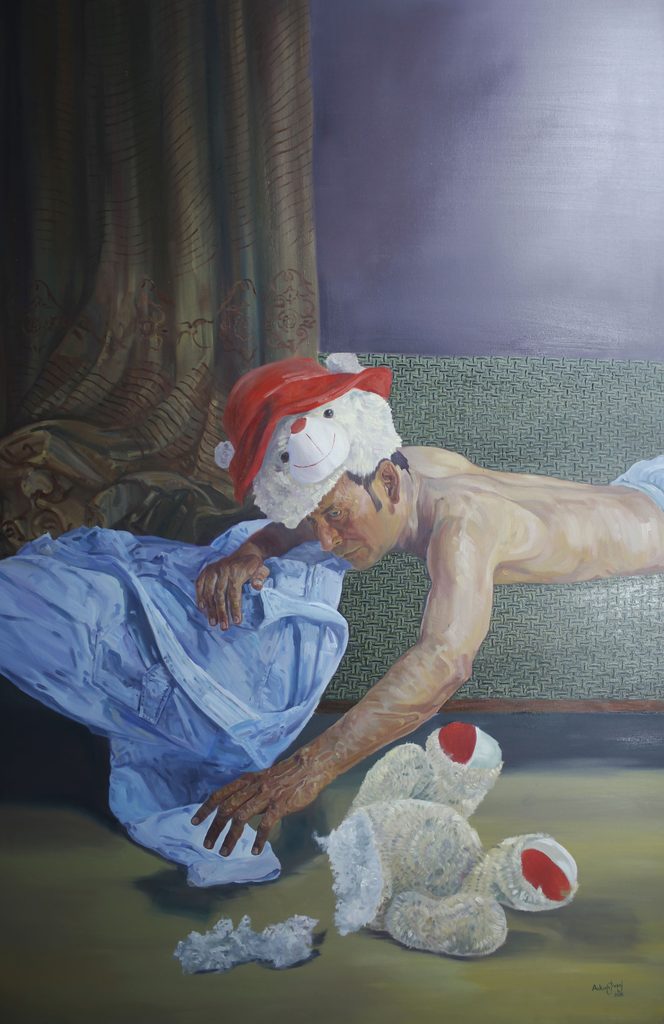
During his training, he once tries to paint something he simply could not execute. No amount of effort enabled him to achieve the stroke he wanted. his teacher eventually told him that he could spend his entire life on that canvas and still fail. The style demanded a confidence and instinct that could only come from repetition and experience.
The painting remains unfinished to this day.
For Aakash, it is a reminder that labour alone cannot always produce mastery, and that some forms of knowing arrive only after years of doing.
An Obsession with Apprenticeship
If Aakash’s first encounter with painting was accidental, his commitment to learning it was anything but. He speaks about his teachers with unusual seriousness, as if they are forces that have hammered his life into shape.
A name that returns most often is Saleem Changezi, a sculptor and drawing instructor. After class on day, Saleem asked Aakash to assist him with studio work, and Aakash agreed immediately. It was not sculpture that drew him in, but the opportunity to remain close to someone from whom he could learn.
“Sir Saleem khatarnaak banday hain, bohat sakht hain.”
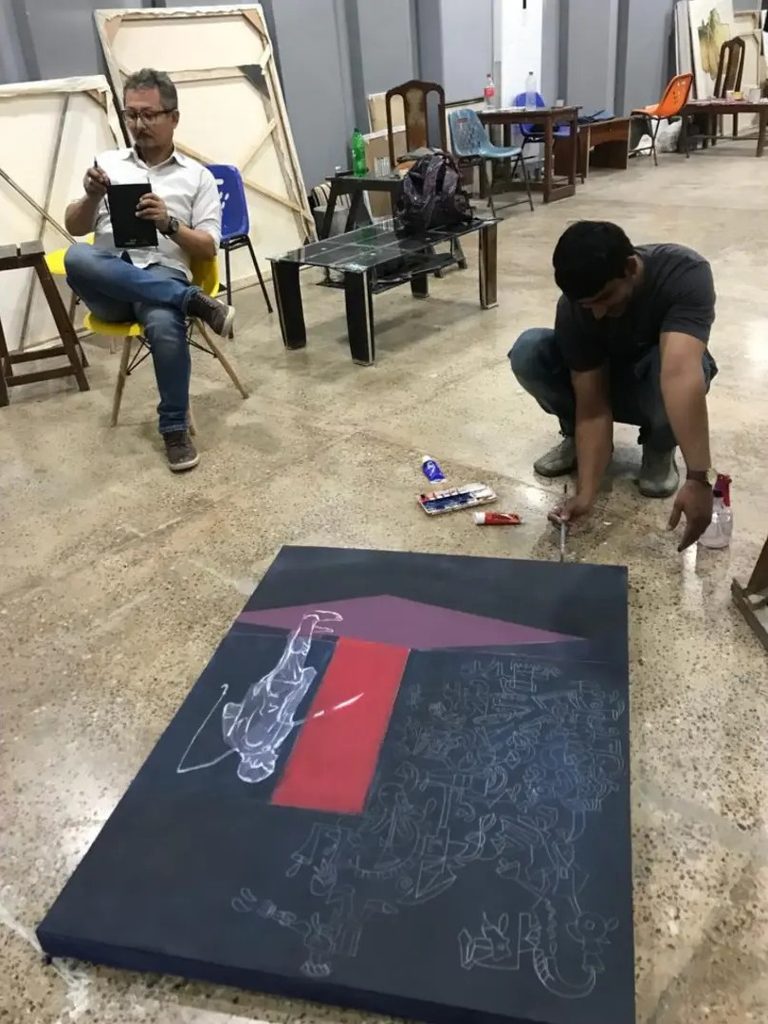
For Aakash, discipline is a condition of learning.
“Seekhna hai to karna paray ga.”
He took that principle literally: for years, his days began early in the morning and ended at midnight, seven days a week. He worked under multiple instructors without pay, giving his time and labour in exchange for access to environments where he could continue learning.
Once, his teacher assumed Aakas wouldn’t come to the studio because it was Holi, but to his surprise, Aakash exclaimed,
“Ye colours paray hain, Holi khelein ge abhi!”
Over time, work replaced leisure and much of his social life. Friendships dissolved through the slow accumulation of absences, and Aakash now has very few friends. He prefers the company of older artists and workers, people whose years of practice he associates with discipline and accumulated wisdom.
The distinction between employment and apprenticeship, between working and being taught, had become less important to him than the work itself.
Predestination and Rebellion
Much of Aakash’s work begins with a question about the structures that precede individual choice. He believes religion, family and gender roles, and moral behaviour are frameworks already set in motion by the time a person begins to understand themselves. They are inherited before they can be questioned, and all resistance is futile.
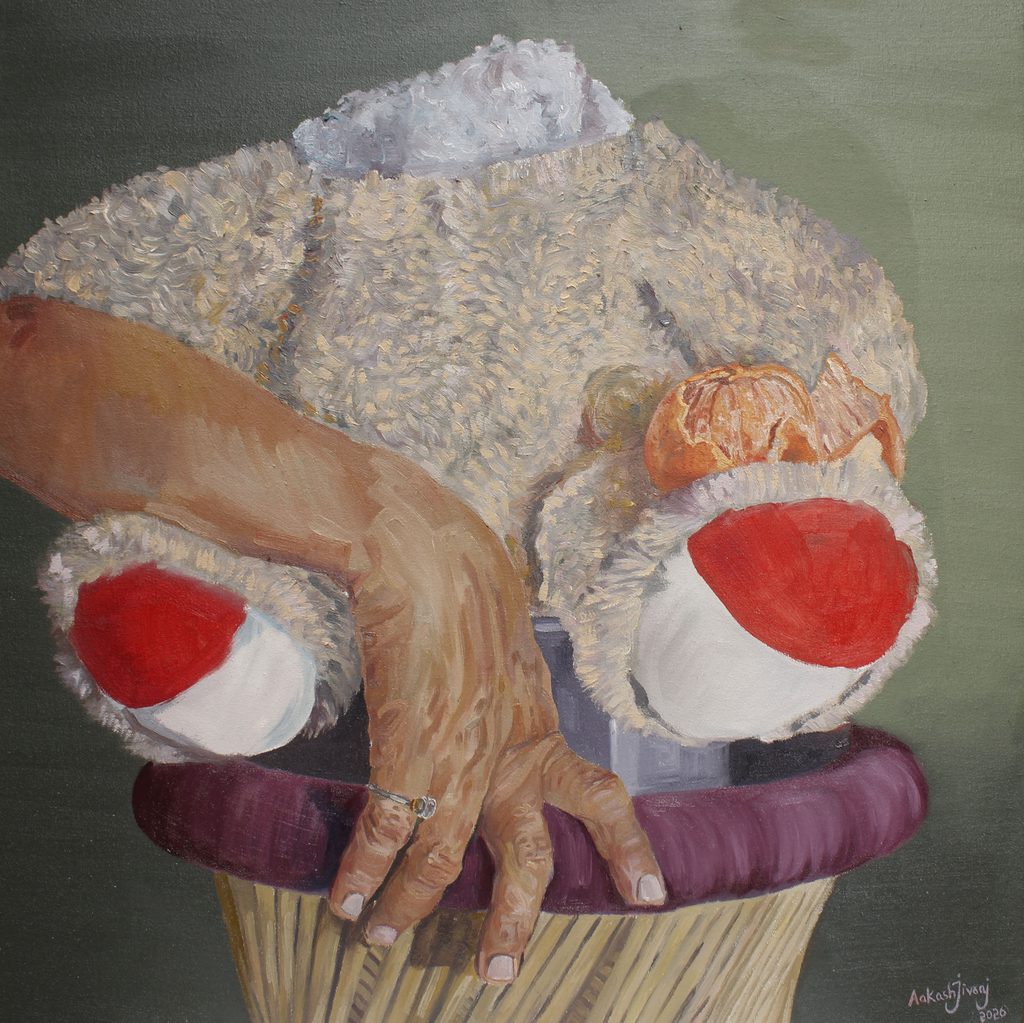
One of his paintings gives this concept an absurdist form: a figure with a teddy bear’s head attempts to push cotton into a radio speaker while a cassette, representing predestination, plays inside it.
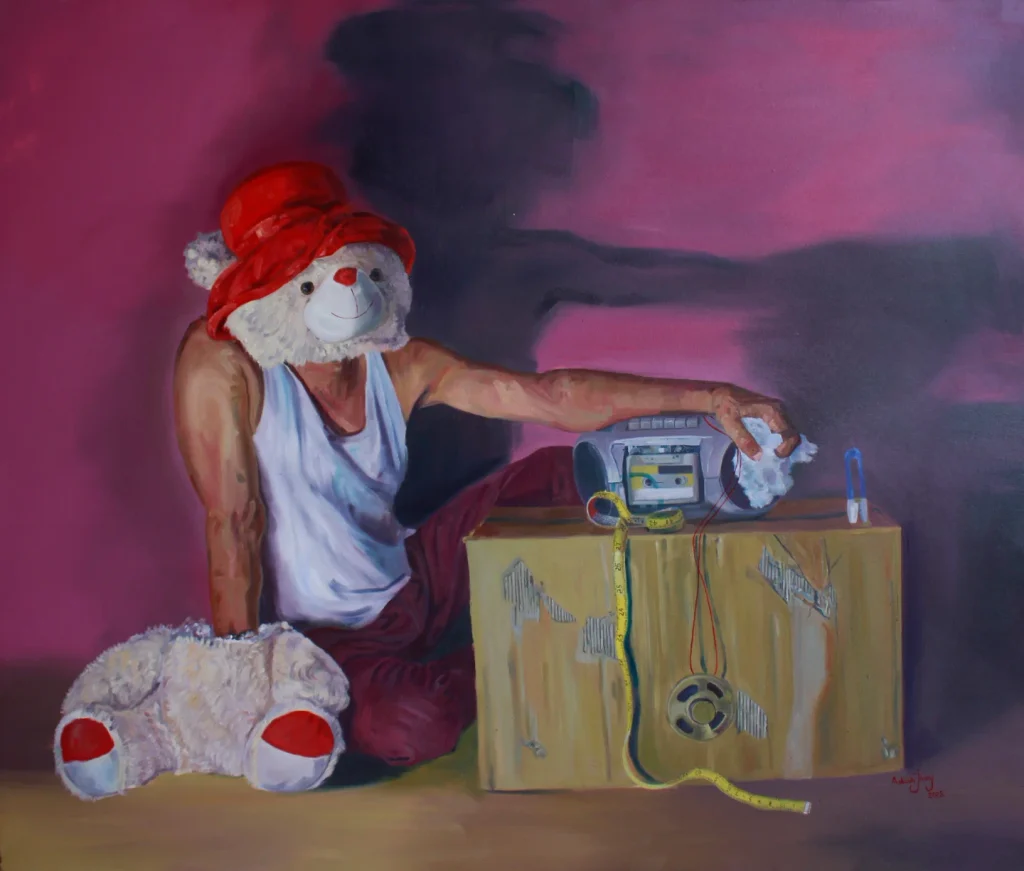
The figure tries to muffle the sound, stuffing cotton into the speaker to silence something that has already begun. The rebellion is in vain, but it is a deliberate and persistent act of trying to interrupt a script that was written before he arrived.
The same tension surfaces in Aakash’s conversations. He notices contradictions in behaviour, social interactions, and the casual acceptance of moral assumptions that others often leave unquestioned. He struggles to find environments where people take his questions seriously rather than dismissing them.
“Aakash ki wife Saraspati ya Seeta ho gi. Fatima nahi ho sakti…
Mein shayad ghalat paida ho gaya hoon idhar…”
During a discussion about a sleeper bus journey involving a transgender passenger who used a restroom assigned to men rather than one assigned to women, Aakash pointed to the ease with which people brushed off contradictions by saying, “Ye to aisay hii hota hai.”
For him, that phrase closes the door on enquiry, allowing something that might demand deeper examination to be rebuffed.
What he wants instead are gheri baatein: conversations that can accommodate contradiction, discomfort, and ambiguity without rushing to resolve them. In their absence, his thoughts accumulate, and what cannot find an outlet in speech eventually lands on the canvas.
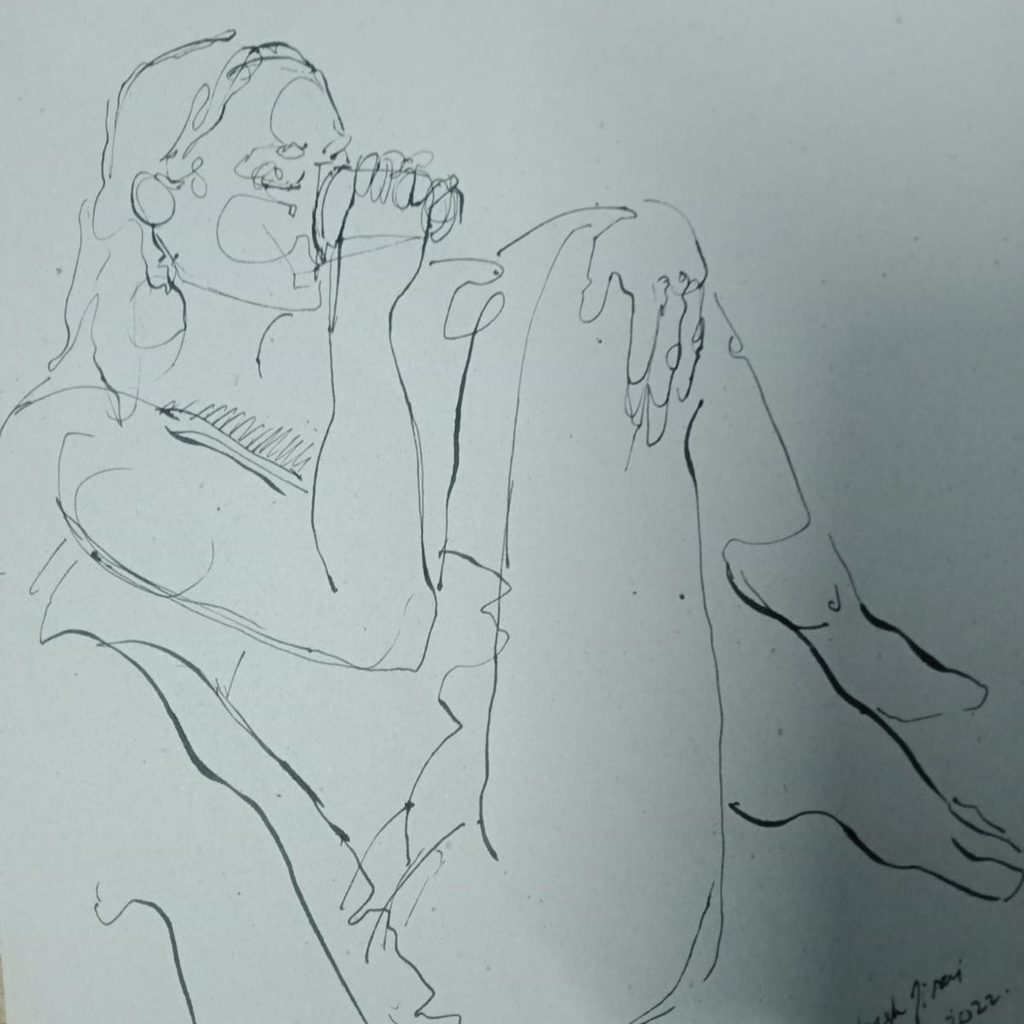
The thoughts that cannot surface in ordinary conversation take form in Aakash’s paintings, where bodies rarely settle into complete or recognisable wholes. His work features figures in partial stability, bodies interrupted by symbolic motifs, and mismatched clothing.
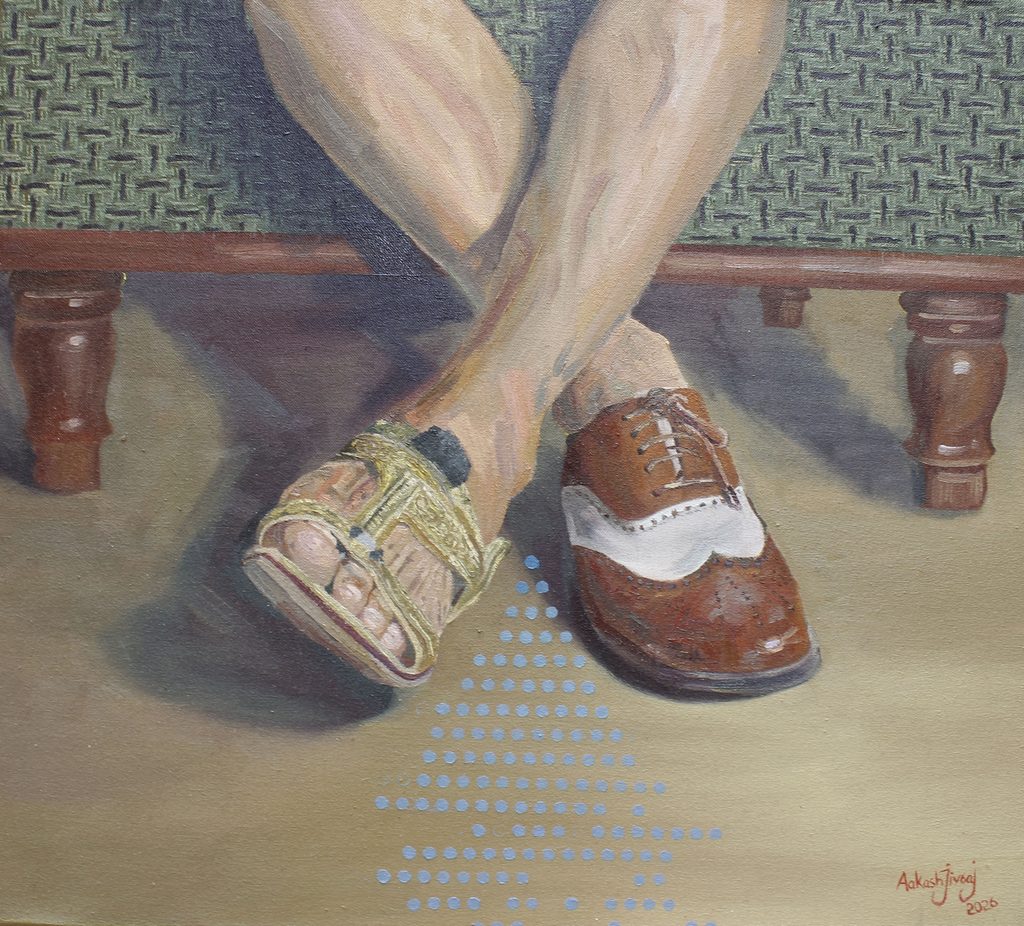
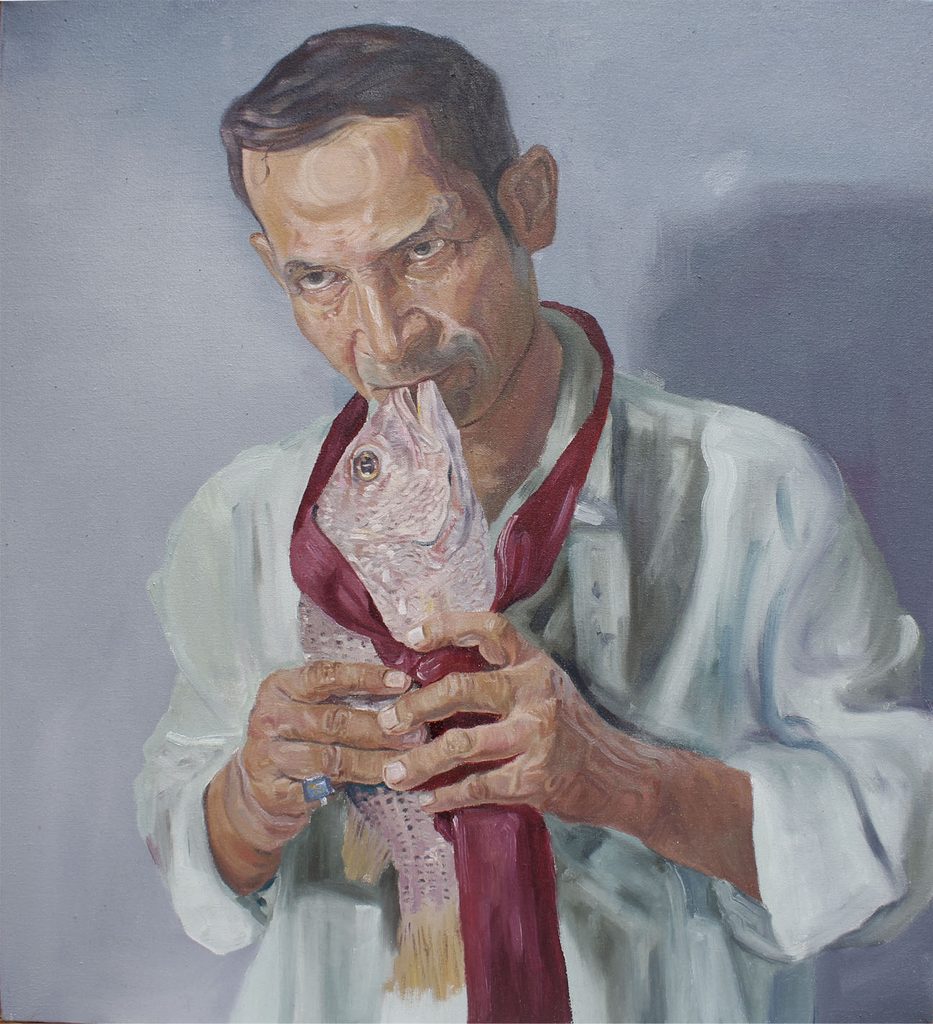
A man holding a fish; a figure wearing mismatched shoes; bodies that are not necessarily incomplete in their physical form but seem to have lost their internal logic.
Aakash explains that the fish, a repeated motif, represents thoughts that cannot be translated into ordinary speech. His paintings resists being reduced to a single explanation, and while the symbols offer a way in, they do not pave way for a definitive reading.
When asked whether this fracture reflects his own life, Aakash pauses.
“Jee.”
He does not elaborate.
Throughout his speech and his work, he references religious disarray, emotional disjointedness, and social isolation. At one point he says, “Mujhe apnay haal pe chhor diya gaya hai.”
This reflection suggests release and abandonment, but no further context is provided.
Aakash’s art becomes a system through which his internal world can be organised without being simplified: while language demands clarity and conformity, the canvas can accommodate nuance.
Gheri Baatein
Rather than describe himself as misunderstood, what Aakash refers to is a feeling of being structurally under-responded to: an absence of reciprocity and attention instead of an absence of people. He speaks as someone who continuously processes more complexity that his surroundings seem willing or able to return. it is not a matter of intelligence or superiority. To put it more precisely, he notices meanings in contradictions that others seem to disregards in the interest of “keeping the peace”.
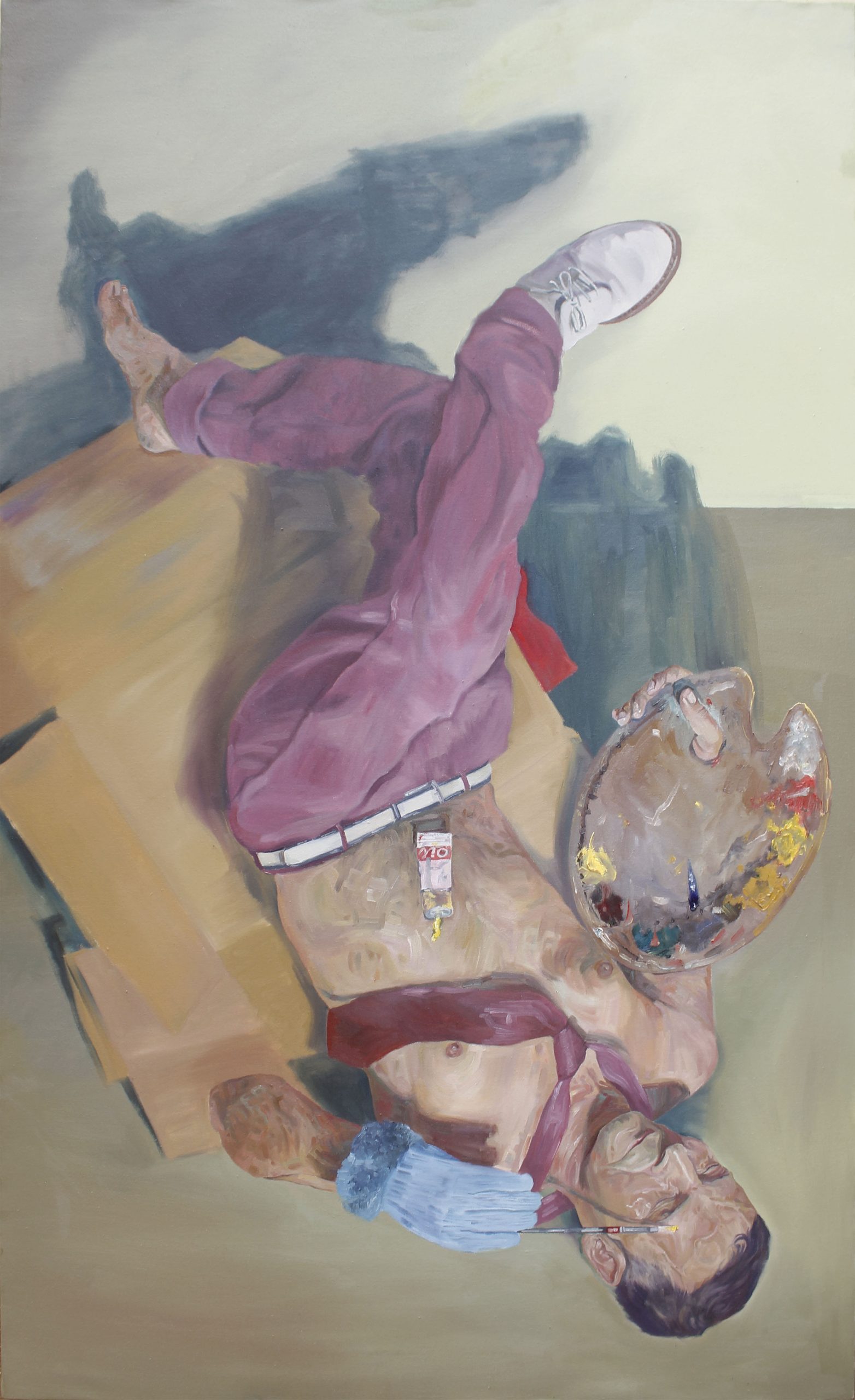
Even small gestures carry weight in his reading. A gift, for instance, is rarely just a gift. It carries an expectation and creates an obligation, ehsaan, an implicit debt that can alter the terms of a relationship.
For Aakash, generosity can also be structurally loaded.
These observations appear in his art, intimate without being reductive. They stage conditions and states of being instead of offering conclusions. The old man who recurs throughout his work is less a character with a defined story than a container for unresolved cognition, fatigue, and distance.
Listening to Lyari
Aakash’s way of seeing is inseparable from Lyari, where he has learned to move through a world dense with languages, contradictions, and the small exchanges that make up everyday life. He speaks Urdu, Balochi, Sindhi, Punjabi, and Kachhi. He jokes that English might have been added to the list if it had existed around him.
Aakash’s linguistic prowess grew from observing the world around him, a skill that also underpins his art. His work draws on overlapping social behaviours, economic contradictions, fleeting encounters, and the unpredictability of people as they move through their everyday lives. His paintings begin with snippets: an overhead sentence, a gesture on the street, a brief interaction that never becomes a complete story; observation has become a method.
He comes across less as a painter and more as someone studying the mechanics of human behaviour.
He watches posture, hesitation, clothing, emotional inconsistency, and the minute signals through which unease reveals itself.
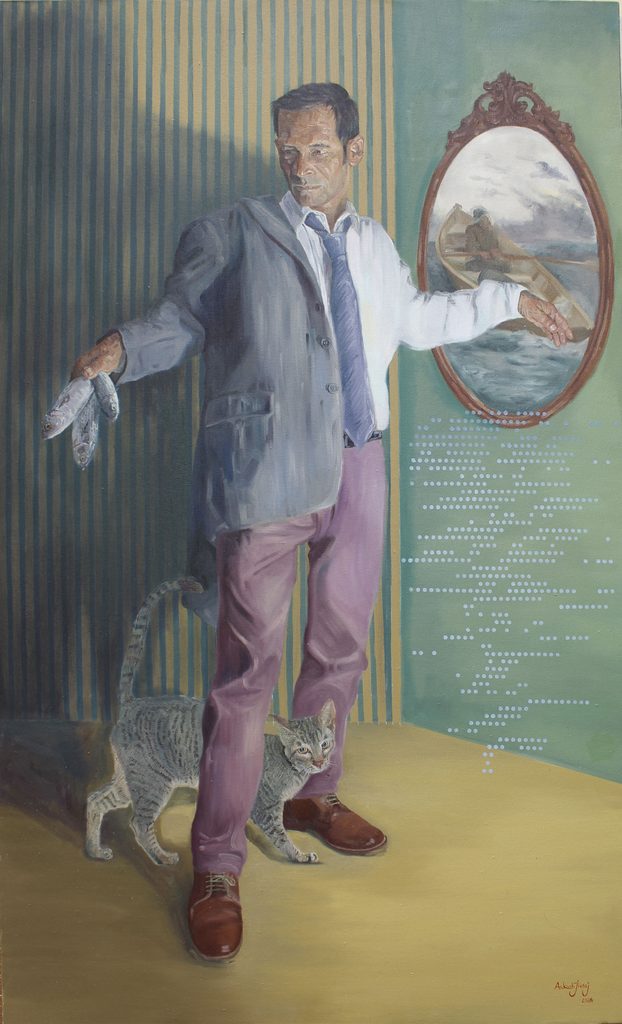
Before the brush touches the canvas, however, there is conceptual labour.
Aakash distinguishes between painting and mazdoori. Painting, he explains, is the act of thinking: working out composition, symbolism, emotional structure, the placement of objects, colour logic, and the internal narrative of an image. Mazdoori is the physical application of paint.
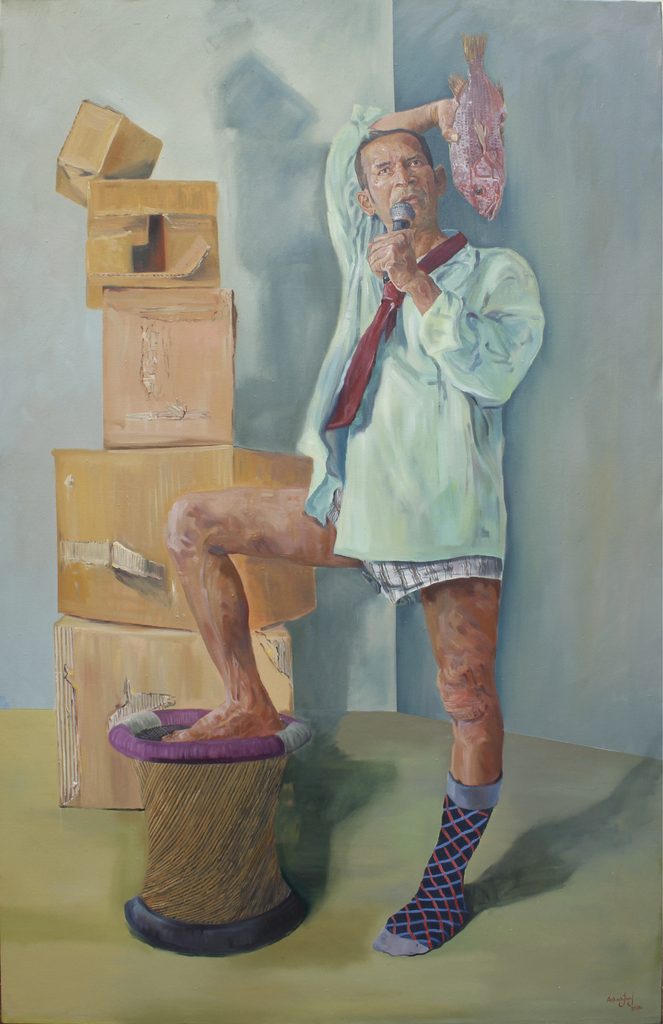
Most of the work happens before execution. A painting can take weeks to resolve in his mind, while the actual mazdoori may take only a day. This is why the objects in his work rarely feel incidental. A fish, a radio, or a figure placed at an unusual angle has emerged from prolonged internal deliberation.
Selling Paintings Without Selling Himself
After graduating from the Arts Council, Aakash began applying to gallery open calls in 2024. He initially believed that creating good work would be enough, but encountering the commercial infrastructure of the art world would be a bitter pill to swallow.
“The higher the price tag, the bigger the artist.”
He now understands that art functions as a business.
Exhibitions, collectors, pricing, and demand shape artistic legitimacy within institutional spaces. However, understanding the market has not made Aakash particularly interested in accommodating it.
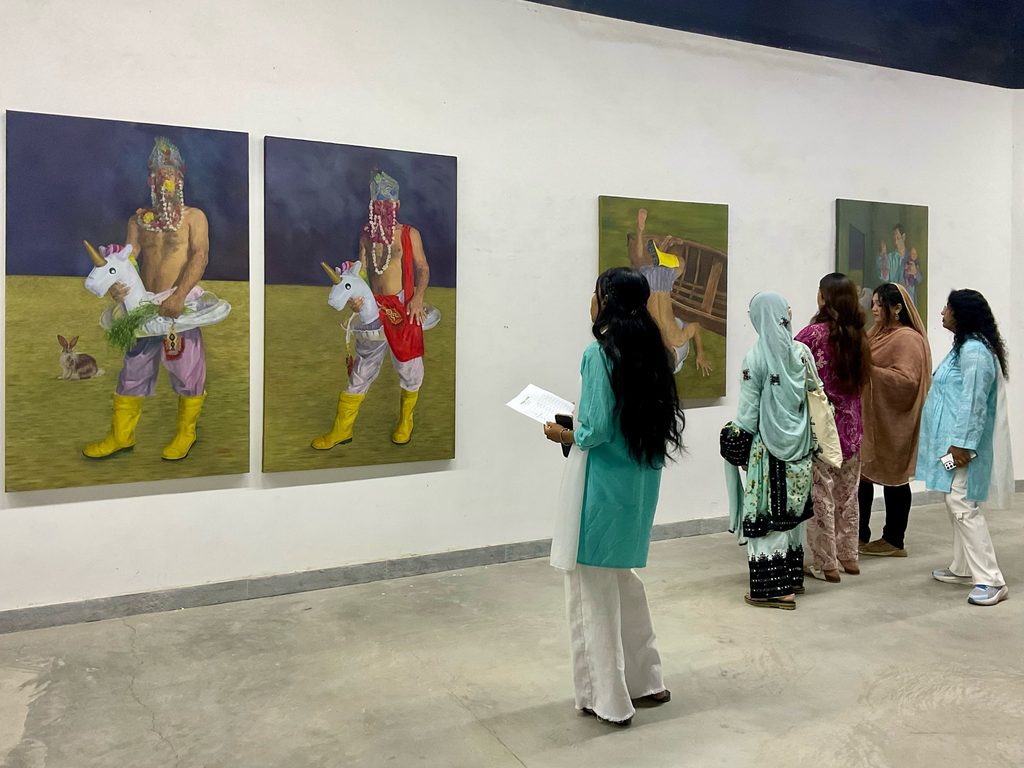
He paints on large canvases despite knowing that many buyers may not have the wall space for them. He refuses commissions and will not repeat previous works, insisting that every piece remain singular.
He fears becoming a “machine” producing predictable commodities for market demand. For Aakash, success means being able to keep painting freely.
“Studio chalta rahay, kaam kartay rahein … Bas gaari chalti rahay.”
His ambitions are materially modest but creatively absolute.
Commercially, it makes little sense, but philosophically, it makes complete sense.
Art Belongs to the People
Near the end of our conversation, Aakash offers a thought that connects his relationship with art to the meanings imposed on him.
While a painting remains inside his studio, it carries the meaning he intended for it. But once it leaves the studio, it no longer belongs to him; it belongs to people.
They may misunderstand it, reinterpret it, or project their own memories, beliefs, politics, fears, and emotions onto it. Some may admire it, and others may reject it entirely. For Aakash, each response becomes valid within the reality of the person encountering his work.
This provides some context as to why he refuses to over-explain his paintings. Every viewer arrives with a different history and a different way of making sense of the world.
What a painting becomes cannot be entirely determined by the person who made it.
There is a symmetry between this philosophy and Aakash’s own life. He has spent much of it questioning the meanings others impose on people: religions shapes morality, society prescribes behaviour, families influence the paths their children are expected to follow, communities attach meaning to identity, desire and purpose before an individual has had the opportunity to determine these things for themselves.
Aakash knows what it is like to find oneself inside a meaning someone else has constructed.
Perhaps this is why he refuses to impose fixed meaning on viewers in return. He can construct the image, but he cannot dictate what another person sees.
“Artist sirf kaam karta hai.”
The interpretations other make of it belong to a world beyond his control.
Aakash cannot always silence the structures that have shaped his life, nor can he make the world receive every thought he carries. On the canvas, however, he can interrupt, rearrange, and question them.
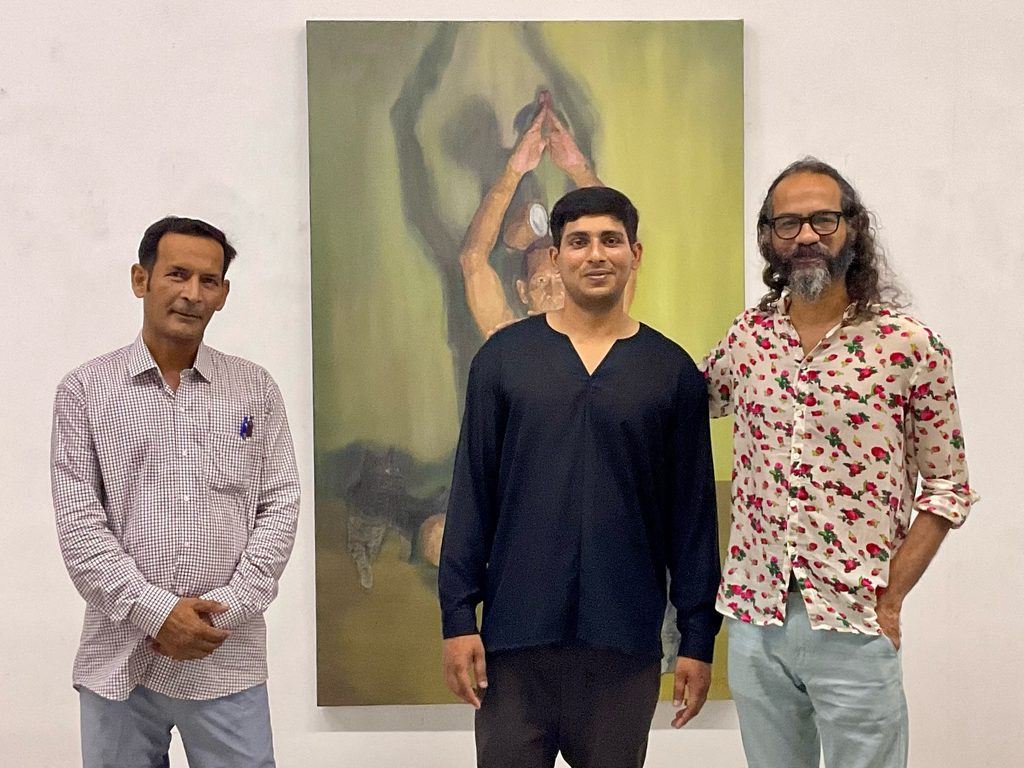
Image from Sanat Initiative.

The Gully Kahani Team approaches storytelling as lived observation, blending on-ground reporting with narrative depth and cultural analysis. Each article is shaped through careful research, street-level perspectives, and a commitment to capturing the layered realities of urban Pakistan. The editorial voice prioritizes nuance over simplification, tracing how history, culture, and everyday life intersect in meaningful ways.
All images used in this article belong to Aakash Jivraj and are reproduced with his consent. Other images may be publicly sourced, with creators credited where appropriate. Interview quotes have been condensed for brevity.